
Cataloochee Valley: The Last of the Eastern Elk
I. When the Mountains Still Knew Them
II. The Long Vanishing
III. What Remains When Something is Gone
IV. Before the Return
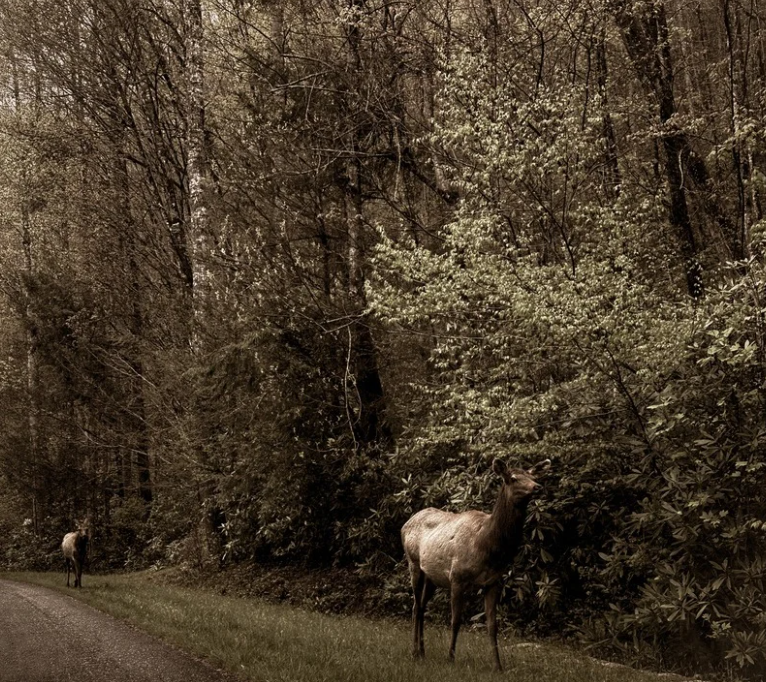
Two elk along the road into Cataloochee Valley. 25 April 2025When the Mountains Still Knew Them
There was a time when the sound of an elk in the Appalachian Mountains would not have been remarkable.
Imagine the southern mountains before roads settled permanently into their valleys: ridgelines folding one behind another, oak and chestnut forests broken by river bottoms, grassy openings, and broad mountain coves. Somewhere along the edge between timber and meadow, an animal nearly the size of a horse moves through the grass.
A bull elk could stand close to five feet at the shoulder. In autumn, his antlers rose above him in branching beams, and his voice carried farther than his body could be seen, a high, strange bugle traveling across a valley and into the trees.
Today, that sound seems perfectly suited to Cataloochee.
For most of the valley’s recorded history, however, it was absent.
The elk seen in the Great Smoky Mountains today belong to a story of restoration. But restoration contains two histories at once: the thing restored, and the thing that happened before restoration became necessary.
The eastern elk, traditionally classified as Cervus canadensis, once ranged across a vast portion of eastern North America. Historical and biological accounts place elk from the Northeast southward through the Appalachian country, including the mountains of what are now North Carolina and Tennessee.
The Appalachians they inhabited were not simply an uninterrupted wilderness of closed forest. Elk flourished where forests met openings in river bottoms, meadows, burned areas, woodland edges. Storms, fire, floods, and human activity continually reshaped these places.
Indigenous peoples had also lived within and shaped eastern landscapes for thousands of years before European colonization. In the southern Appalachians, that history includes the Cherokee, whose relationship with this mountain country long predates the boundaries and place names familiar to us today.
What came next was not simply the arrival of hunting. It was a change in its scale, technology, economy, and a simultaneous transformation of the land itself.
The Long Vanishing
As European settlement expanded, forests and river bottoms became farms, roads, settlements, and pasture. Elk were hunted for household use, hides, commercial markets, and sport.
For an animal so large, abundance could become a liability.
An elk provided considerable meat and a valuable hide. Herds returned to feeding grounds and traveled recognizable routes. Increasingly, the places where elk found food and cover were also the places being cleared, settled, and hunted.
Elk could tolerate disturbance. What they could not indefinitely tolerate was disturbance everywhere combined with relentless killing.Their disappearance did not happen neatly.
There was no single moment when the eastern mountains woke to discover their elk were gone. Instead, herds grew smaller. Sightings became less frequent. Hunters traveled farther. An animal once ordinary enough to be taken for granted became notable enough to remember.
Then even the memories grew scarce.
In the southern Appalachians, this happened relatively early. Great Smoky Mountains National Park reports that the last elk in North Carolina is believed to have been killed in the late 1700s, while Tennessee’s last is generally placed in the mid-1800s. Other National Park Service material describes elk as disappearing from the southern Appalachians in the early nineteenth century.
Early records are incomplete, and historical writers did not always use animal names consistently. What we can say is elk declined sharply in North Carolina by the late eighteenth century and disappeared from the southern Appalachian landscape as a viable wild population.
Perhaps that uncertainty tells the story better. Extinction is rarely a single gunshot echoing through history. More often, it is a narrowing.
A range becomes a region. A region becomes a valley. A herd becomes a handful of animals. An animal becomes a story someone remembers hearing.
By the end of the nineteenth century, the eastern elk was gone.
What Remains When Something Is Gone
The strange thing about losing a species is that the landscape remains.
Streams continue through the same valleys. Oaks leaf out. Autumn still moves down the ridges. Children grow up learning the animals around them and naturally assume these are the animals that belong there.
Absence becomes difficult to see.
Ecologically, the disappearance of elk removed one of the East’s largest herbivores. Elk graze, browse woody vegetation, move nutrients, and influence the openings and forest edges they inhabit
But something less measurable disappeared too. The East lost the experience of being a place with elk.
That distinction interests me because we usually learn a landscape by what we can see: its forests, rivers, buildings, farms, and wildlife. Yet every landscape also holds an invisible inventorythings removed, buried, displaced, extinguished, or simply forgotten.
Sometimes understanding a place means learning to notice those absences.
By the time Great Smoky Mountains National Park was established in 1934, wild elk had already been missing from these mountains for roughly a century or more. The mountains preserved inside the new park were extraordinarily rich, but they were not an untouched version of some earlier world. Pieces had already disappeared. Elk were one of them.
And Cataloochee itself had changed many times.
Cherokee people knew and traveled through this mountain country long before nineteenth-century Euro-American families established farms in the valley. Those settlers built homes, barns, churches, schools, orchards, and fields. By 1910, Big and Little Cataloochee together held more than twelve hundred residents.
Then the landscape changed again. With the creation of Great Smoky Mountains National Park, residents left. Buildings disappeared. Fields narrowed. Forest returned to places where families had once planted crops and grazed livestock.
This is how a landscape forgets. Not because the land carries no memory, but because human memory is short compared with ecological time.
Before the Return
Today, it is difficult to picture Cataloochee without them.
There are mornings when elk step into the valley’s open fields while mist still rests against the mountains. In autumn, the bugle of a bull can travel across the same valley where generations once lived without ever hearing it.
But that is the next part of the story.
For now, we know that for so long, the mountains became so accustomed to the absence of elk that generations could inherit the Smokies without realizing something enormous was missing.
Perhaps this is one reason I love learning the history of a place before visiting it.
Knowledge changes the view. A meadow stops being only a meadow. A forest edge becomes habitat. An old field becomes evidence of another landscape beneath the present one.
Sources
North Carolina Wildlife Resources Commission. “Elk.” North Carolina Wildlife Profiles.
Overview of the eastern elk’s historic range and decline, including the last known wild eastern elk killed in Pennsylvania in 1877.
National Park Service. Environmental Assessment for the Establishment of Elk in Great Smoky Mountains National Park. 2010.
Historical background on the eastern elk, its former Appalachian range, population decline, and eventual extirpation.
National Park Service. “Elk.” Great Smoky Mountains National Park.
Historical overview of elk in the southern Appalachians, including their former abundance and disappearance from North Carolina and Tennessee