
Cataloochee Valley: The Return of the Elk in the Smoky Mountains
I. The Question of Return
II. Why Cataloochee?
III. The First Twenty-Five
IV. A Herd Takes Hold
V. The Valley They Returned To
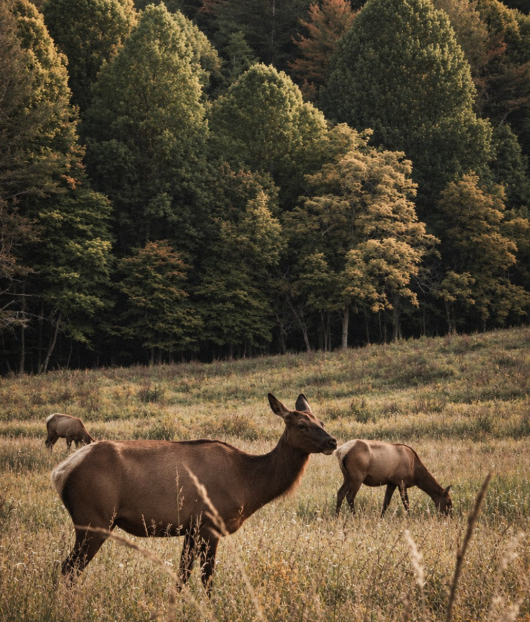
An elk herd at dusk 6 June 2026I. The Question of Return
Last week, we traced the story of the eastern elk through the southern Appalachians, from an animal once at home among these mountains to one that disappeared from them entirely.
That story ended in absence.
For nearly two centuries, the forests of the Smokies carried on without elk. By then, their disappearance belonged to another generation, distant enough that a landscape without them had come to seem ordinary.
But the story of the elk in these mountains did not end with the last eastern elk. An unlikely question began to be considered:
Could elk return?
It was not a question of recovering the eastern elk. That animal was gone. Instead, wildlife managers began considering whether another population of elk could be established within part of its former range.
By the late twentieth century, successful elk restoration efforts elsewhere in the United States suggested that such a return might be possible. In Great Smoky Mountains National Park, the idea developed into a proposal for an experimental reintroduction.
There was no certainty that it would work. Elk would need adequate forage and space. Their movements would have to be monitored. Their effects upon vegetation, other wildlife and surrounding communities would have to be understood. And the animals themselves would have to learn to inhabit a landscape none of them had ever known.
Before an elk could return to the Smokies, however, there was another question to answer: Where should they begin?
II. Why Cataloochee?
The answer was Cataloochee. Tucked within the mountains of western North Carolina, the valley offered a combination difficult to find elsewhere in the heavily forested Smokies: broad areas of open grassland surrounded by protected mountain country.
The fields there had been cleared and maintained by the families who settled Cataloochee, cultivated as farmland and pasture long before the creation of the national park. By the end of the twentieth century, the people who created them were gone, but portions of the open landscape remained.
So did scattered apple trees, barns, churches, houses and other fragments of the community that once occupied the valley.
Those areas would eventually help make Cataloochee suitable for elk. I find something remarkable in that connection and symmetry. The histories overlap in ways no one living through either of them could have anticipated.
Cataloochee had already been transformed many times by settlement, cultivation, departure and the gradual return of forest. Now another chapter in the valley's history would begin upon the same ground.
In early 2001, preparations were made to receive the first animals.
III. The First Twenty-Five
In February 2001, twenty-five elk arrived in Cataloochee Valley.
They had come from Land Between the Lakes along the Kentucky-Tennessee border, transported hundreds of miles into mountains where elk had once been native but had not lived for generations.
For several weeks, the animals remained within a large acclimation enclosure in the valley. The enclosure gave them time to adjust to unfamiliar surroundings before entering the wider landscape of the park.
Then, on April 2, 2001, the gates were opened.
It is difficult to imagine what that moment must have looked like without lending it more ceremony than it probably possessed. There was no way of knowing whether those animals represented the beginning of a restored population or merely a brief experiment.
There were only twenty-five of them. Twenty-five elk stepping beyond an enclosure and into mountains that had not held a resident herd within living memory.
The following year, twenty-seven more elk were brought from Elk Island National Park in Alberta, Canada. With their arrival, the founding population numbered fifty-two.
The return had begun. Whether it would last was another matter entirely.
IV. A Herd Takes Hold
By the end of the first decade, the question that had followed the elk since their arrival was beginning to have an answer. They had stayed.
The herd had grown beyond those first fifty-two animals, and elk had begun to move beyond Cataloochee into the surrounding mountains and valleys of western North Carolina. Calves were being born into the Smokies rather than carried into them. A population once dependent upon careful introduction was beginning to sustain itself.
In 2011, ten years after the first twenty-five elk arrived, the National Park Service brought the experimental phase of the reintroduction to a close. The elk would remain, now managed as a permanent population within Great Smoky Mountains National Park.
It was a quiet milestone for something that, historically, was rather extraordinary.
Their return was not without complication. Elk do not recognize park boundaries, and as the herd expanded, animals wandered onto neighboring lands and into communities beyond the protected valleys of the Smokies. Their presence required continued management and a new kind of coexistence between a large wild animal and a landscape far more inhabited than the one its predecessors had known.
But perhaps that, too, is part of the story of restoration. Returning a species does not mean returning the world that once surrounded it. The elk had to find a place in the Smokies as they existed now.
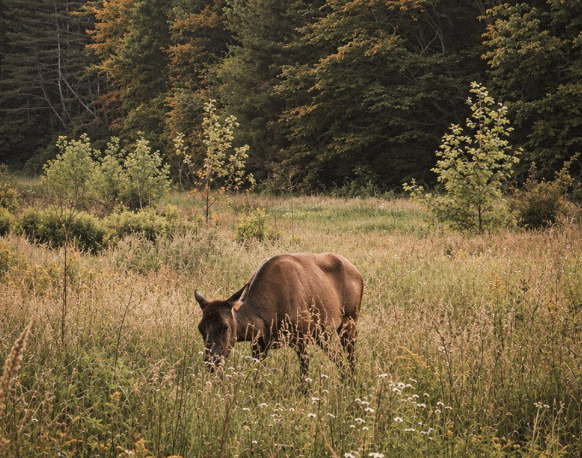
A lone elk at dusk
6 June 2026
V. The Valley They Returned To
Today, an elk may graze within sight of a house built more than a century ago. An old orchard may stand at the edge of a field where a bull gathers his harem in autumn. The forest presses against places once kept open by people, while elk now help write another history across the same ground.
It would be easy to look at such a scene and imagine wilderness restored. But Cataloochee is more interesting than that. It is not a landscape returned to some untouched beginning. It bears too much evidence of everyone and everything that came before.
The old community remains within it. So does the absence of the eastern elk. And now, so does their return in another form. Cataloochee has not gone backward.
It has simply continued.
Sources
National Park Service. “Elk.” Great Smoky Mountains National Park.
Overview of elk history and reintroduction in the Smokies, including the 2001 and 2002 releases.
National Park Service. “Wildlife Management and Science.” Great Smoky Mountains National Park.
Historical information on the experimental elk reintroduction, early calf mortality, and black bear management.
National Park Service. “Elk Environmental Assessment Approved.” Great Smoky Mountains National Park, 27 October 2011.
Documentation of the transition from the experimental reintroduction program to management of a permanent elk herd.
U.S. Geological Survey. “No Long-Term Effect of Black Bear Removal on Elk Calf Recruitment in the Southern Appalachians.” 2023.
Research on the early reintroduced population, calf survival, and black bear predation in Cataloochee.
U.S. Geological Survey. “Spatially Explicit Capture-Recapture Using Fecal DNA to Estimate Elk Population Abundance and Growth in Western North Carolina, USA.” 2025.
Research documenting the growth and geographic expansion of the restored western North Carolina elk population.