
Notre-Dame: Written in Stone
I. A Cathedral You Could Read
II. The Twenty-Eight Kings
III. The Faces that Disappeared
The western façade of Notre-Dame was constructed primarily during the first half of the thirteenth century, several decades after work on the cathedral began in 1163. Its sculptures were conceived alongside the architecture itself, not applied afterward as embellishment. The result is something closer to a monumental visual text: Christian history, theology, morality, political authority, and medieval ideas about the structure of the universe translated into stone.
To stand before the façade, then, is to stand before something that was meant to be read.
The difficulty for us is that we have largely forgotten the language.
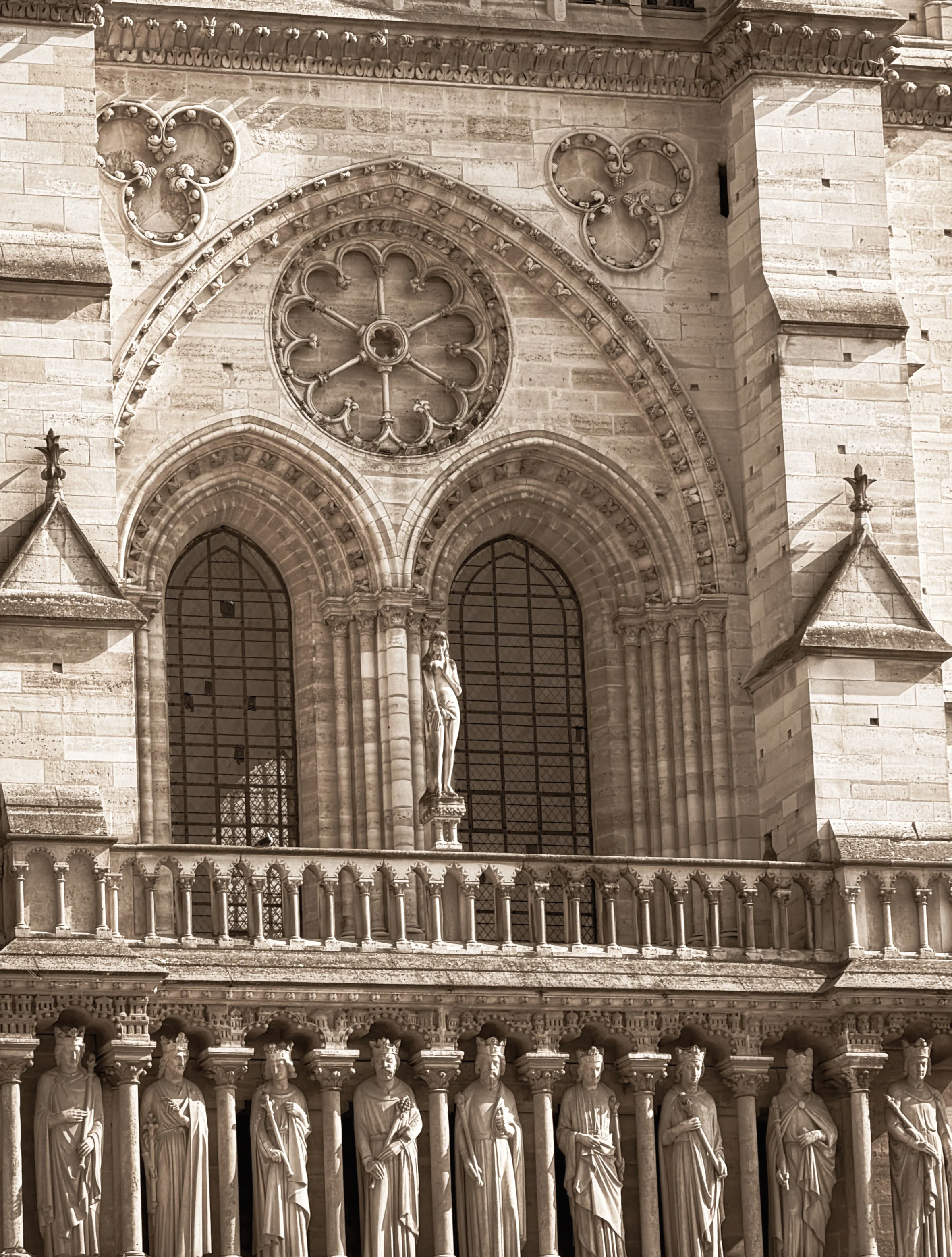
A Cathedral You Could Read
It is easy to imagine medieval Europe as a world without information simply because much of its population could not read written texts. But that misunderstands the ways information could be communicated.
Images mattered.
Symbols mattered.
Where a figure stood mattered. What it carried mattered. What appeared above it, below it, and beside it mattered.
The portals of a medieval cathedral could communicate biblical narratives and Christian teachings to people who would never personally read a Bible. Notre-Dame's own description of its western façade makes this function explicit: its biblical figures allowed people unable to read Scripture to encounter Christian stories through images.
That idea completely changes the way I look at the cathedral.
What can seem from a distance like an overwhelming abundance of carved stone begins to resolve itself into a system. The figures are not simply filling available space. They belong to narratives.
And those narratives begin before you ever cross the threshold.
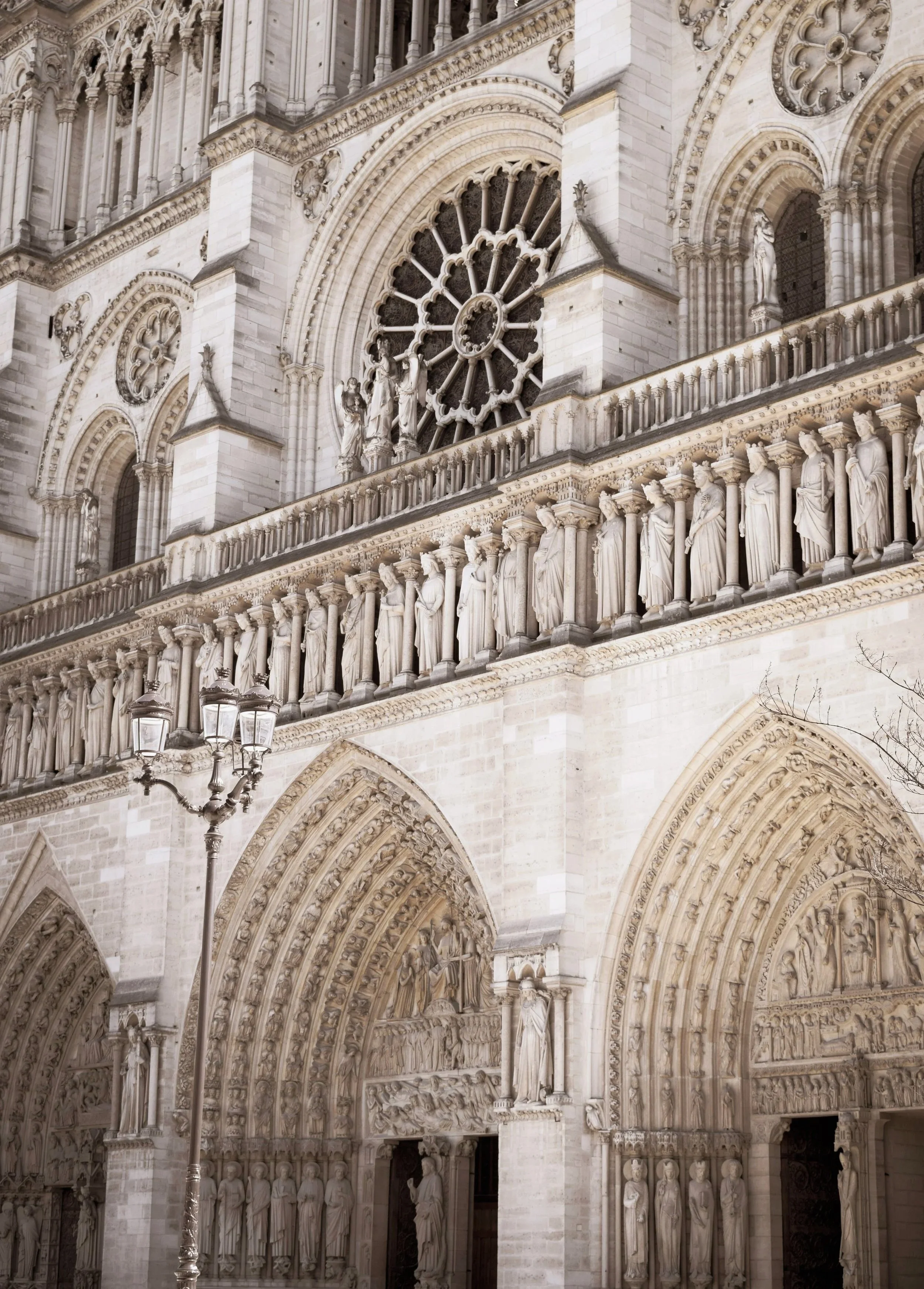
The three great portals at the base of Notre-Dame's western façade each tell a different story: the Portal of the Virgin on the left, the Portal of the Last Judgment in the center, and the Portal of Saint Anne on the right.
Together, they transform the entrance into something much more complicated than a doorway.
You pass through a story to enter the cathedral.
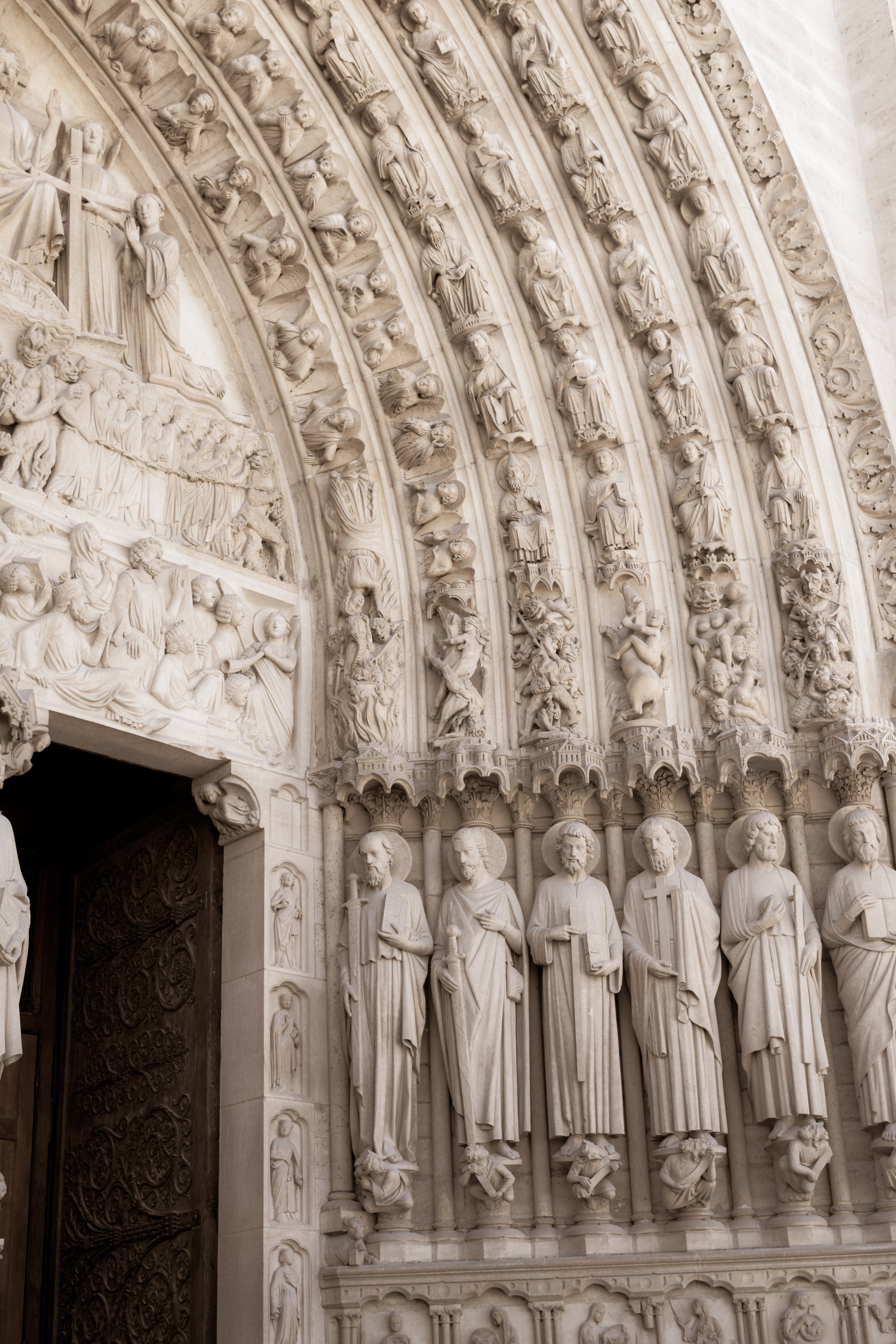
-
Notre-Dame means Our Lady, and the cathedral's dedication to the Virgin Mary is made visible throughout the building. It is especially explicit here.
Installed around 1210–1220, the Portal of the Virgin traces Mary's death, her Assumption into heaven, and her coronation as Queen of Heaven.
The narrative unfolds vertically.
That vertical movement matters.
Medieval church sculpture frequently uses physical position to communicate spiritual hierarchy. What is earthly appears below; what is heavenly rises above it. The architecture itself becomes part of the storytelling.
Mary's story therefore does not simply occur across the stone. It ascends.
And this is one of the details I find most compelling about Gothic architecture: meaning is rarely confined to a single object. Sculpture, architecture, placement, proportion, and movement work together.
Even before entering the cathedral, your eyes are being taught to travel upward.
There is another detail worth remembering when imagining these sculptures in the Middle Ages. The façade we see today (with its familiar shades of limestone) would not always have appeared so monochromatic. Traces of pigment discovered on thirteenth-century sculptures show that Notre-Dame's statuary was once painted.
That can be strangely difficult to picture.
Centuries have trained us to associate medieval sculpture with bare stone. We often interpret that weathered surface as part of its intended aesthetic: austere, ancient, almost solemn.
But the medieval façade would have been more visually immediate.
Color would have separated garments, figures, objects, and scenes. The stories carved around the doors would have been more legible and, perhaps, more alive.
What we now think of as the appearance of antiquity is partly the appearance of what time has removed.
-
The largest of the three entrances occupies the center of the façade.
Its subject is difficult to misunderstand.
This is the Last Judgment.
Created in the early thirteenth century and installed after the other two portals, the central portal depicts the Christian belief that the dead will rise and humanity will face divine judgment.
Look closely and the scene begins almost like a sequence of frames.
Along the lower lintel, the dead emerge from their graves.
They are not all the same. Different kinds of people appear among them—a reminder that death and judgment disregard the social distinctions that structured medieval life.
Above them comes the weighing of souls.
The Archangel Michael holds the scales while demons attempt to interfere. The blessed move toward salvation; the damned are led elsewhere.
Above everything sits Christ.
It is theology made physical.
But what interests me most about the portal is not simply what it depicts. It is where the medieval builders chose to put it.
At the door.
Every person entering through the cathedral's principal portal passed beneath an image concerned with mortality, moral choice, consequence, and the fate of the soul.
That placement gives the sculpture a force that is easy to lose when we encounter medieval art in museums.
In a museum, a sculpture becomes an object.
Here, sculpture becomes an environment.
You move beneath it.
The medieval visitor did not necessarily stand at a respectful distance and analyze the composition as we might in an art-history book. The imagery occupied the physical space between ordinary life outside and sacred space within.
There is something almost architectural about the idea.
The Last Judgment is not simply represented above the entrance.
It becomes the entrance.
The body physically crosses beneath judgment before entering the cathedral.
That relationship between image and movement is one of the reasons Gothic churches are difficult to understand through photographs alone. Their meaning is not contained exclusively in individual artworks. It exists in the relationship between the artwork, the building, and the person moving through it.
-
The portal on the right is quieter in some ways, but historically it may be the most intriguing of the three.
The Portal of Saint Anne is the oldest.
Installed around 1200, it incorporates sculpture made roughly fifty years earlier for the cathedral that preceded the present Notre-Dame. Those earlier pieces retain a more Romanesque character, making the portal something of an architectural memory embedded within the newer Gothic building.
I love this detail because we often imagine monumental buildings as though they were conceived once, constructed according to a single perfect plan, and then preserved intact.
Notre-Dame has never really existed that way.
Even while the Gothic cathedral was being created, pieces of an older Paris were being incorporated into it.
The portal itself contains scenes associated with Mary and the childhood of Christ. At its center, the Virgin and Child appear alongside figures representing royal and ecclesiastical authority—a visual reminder of the close relationship between Christianity and monarchy in medieval France.
But the reused sculpture is what stays with me.
A cathedral built to endure did not begin by erasing everything that came before it.
It absorbed part of its predecessor.
Its history does not exist in neat layers where one century ends and another begins. Different moments survive beside one another.
The cathedral is medieval.
But even within the medieval cathedral, there are older fragments.
And over the centuries, newer fragments would join them.
The Twenty-Eight Kings
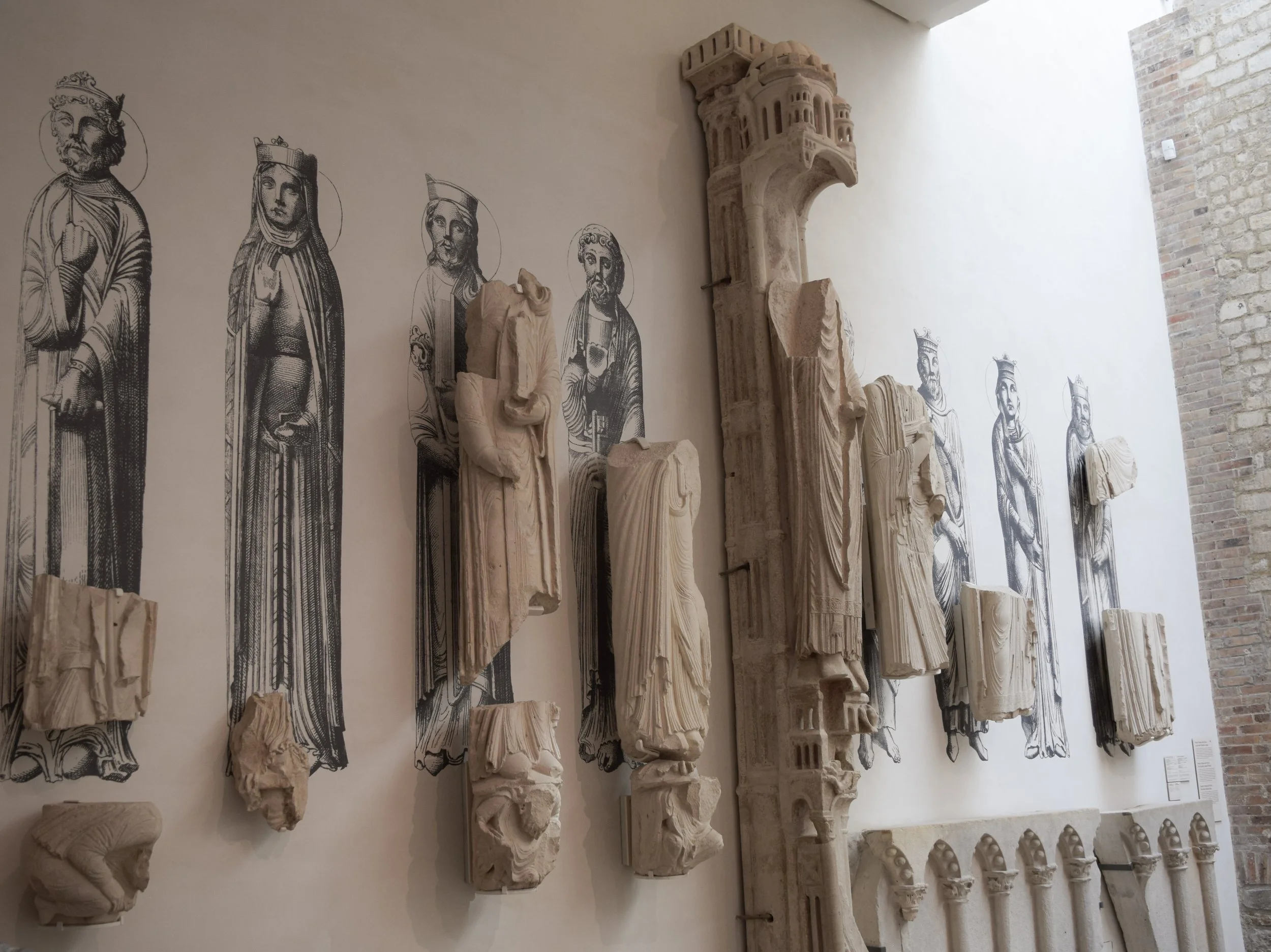
Stretching horizontally across the façade is a row of twenty-eight monumental figures known as the Gallery of Kings. They represent the biblical kings of Judah and Israel, the royal ancestors of Christ.
Today that identification seems straightforward. During the French Revolution, it became disastrously confused.
Revolutionaries saw a row of crowned figures on one of the most important buildings in Paris and interpreted them as representations of the kings of France.
In 1793, the statues were pulled down and decapitated.
The irony is remarkable.They destroyed kings. Just not the kings they thought they were destroying.
There is a tendency to think of monuments as witnesses to history, as stable objects that stand silently while human events unfold around them. Notre-Dame complicates that idea. Sometimes monuments are not merely witnesses.
They become participants.
Their meanings change according to who is looking at them. To a medieval Christian, these figures belonged to a biblical genealogy. To a revolutionary Parisian, a crown could represent monarchy and oppression. To a nineteenth-century restorer, the empty spaces represented something that ought to be reconstructed.
To us, the replacement statues are part of the familiar face of Notre-Dame.
The stone did not change its subject. The world around it changed its interpretation.
And sometimes interpretation has physical consequences.
The Faces That Disappeared
For a long time, the original medieval kings were believed lost.
Their replacements were created during the great nineteenth-century restoration of Notre-Dame led by Eugène Viollet-le-Duc and Jean-Baptiste Lassus.
And then the story took a turn that feels almost too perfect to be true.
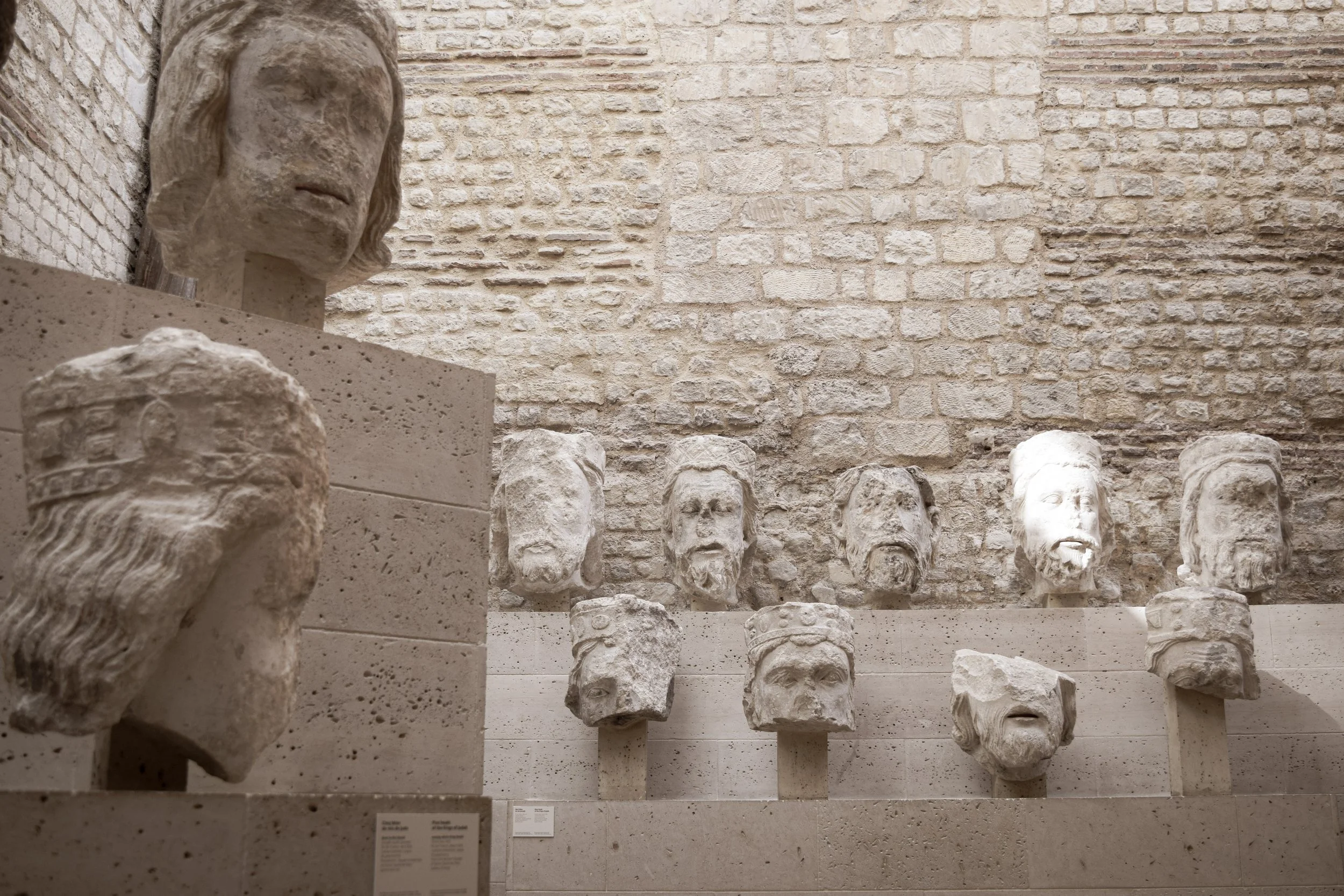
In 1977, workers renovating a private building in Paris uncovered hundreds of sculptural fragments that had been buried there. Among them were heads belonging to the medieval kings removed from Notre-Dame during the Revolution.
Pieces of the cathedral had survived beneath the city.
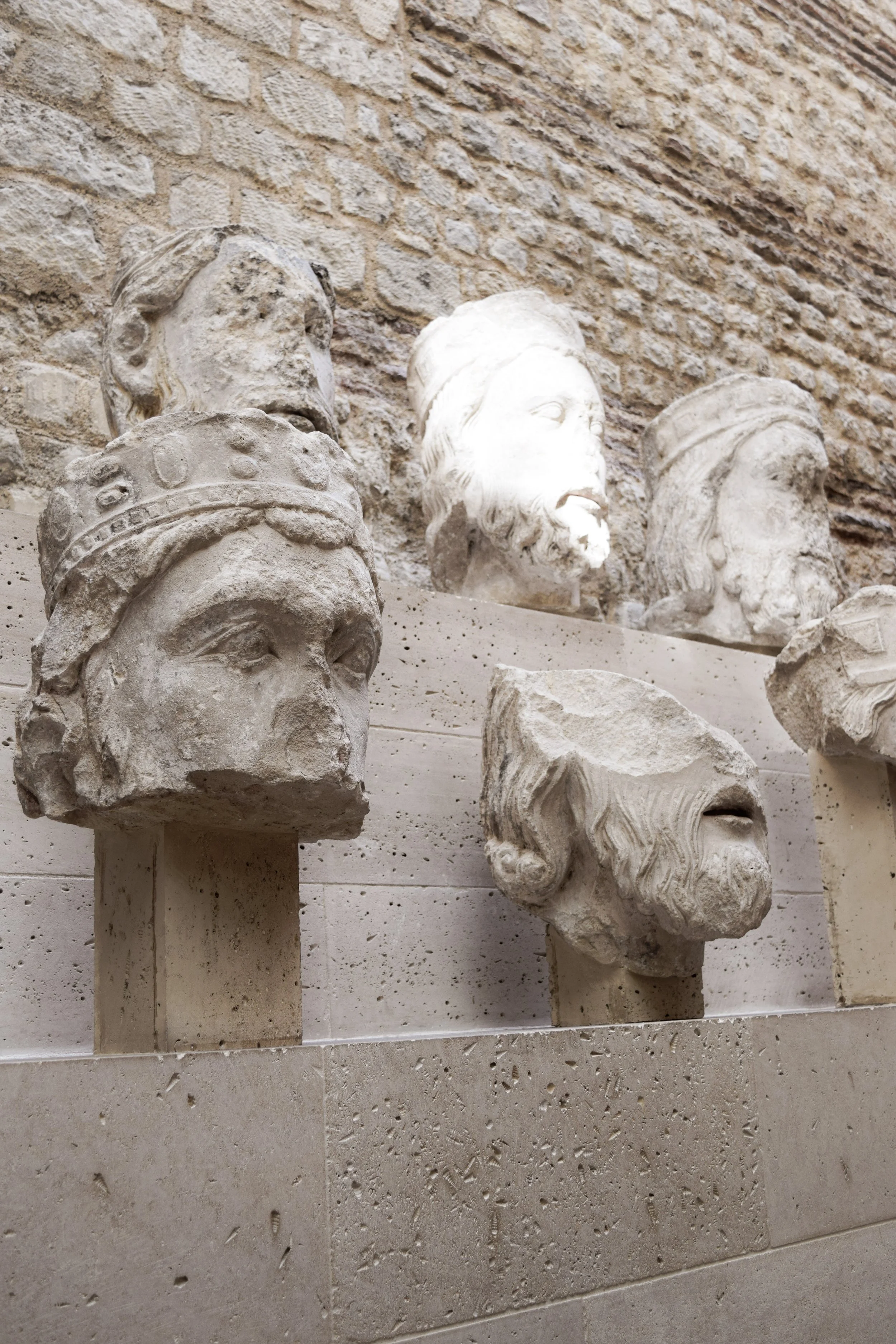
Today, many of those original heads are preserved at the Musée de Cluny, the National Museum of the Middle Ages in Paris.
I find them more affecting there than I expected.
Removed from the architectural order of the façade, they become individual faces.
Their noses are broken. Their surfaces are scarred. Some carry the unmistakable evidence of deliberate destruction.
And yet they survived.
There is an interesting inversion in seeing them in a museum.
At Notre-Dame, you see replacements occupying their original architectural positions.
At Cluny, you encounter the originals displaced from the building.
One has context without authenticity.
The other has authenticity without context.
Neither experience is complete by itself.
Perhaps that is why the story has stayed with me.
It forces an uncomfortable question about what we mean when we call a building "historic."
Is Notre-Dame the original medieval stone?
Is it the design?
Is it the accumulated work of generations?
Is a nineteenth-century replacement less part of Notre-Dame because the sculpture it replaces was carved six centuries earlier?
There is no clean answer.
And Notre-Dame becomes more interesting once we stop expecting one.